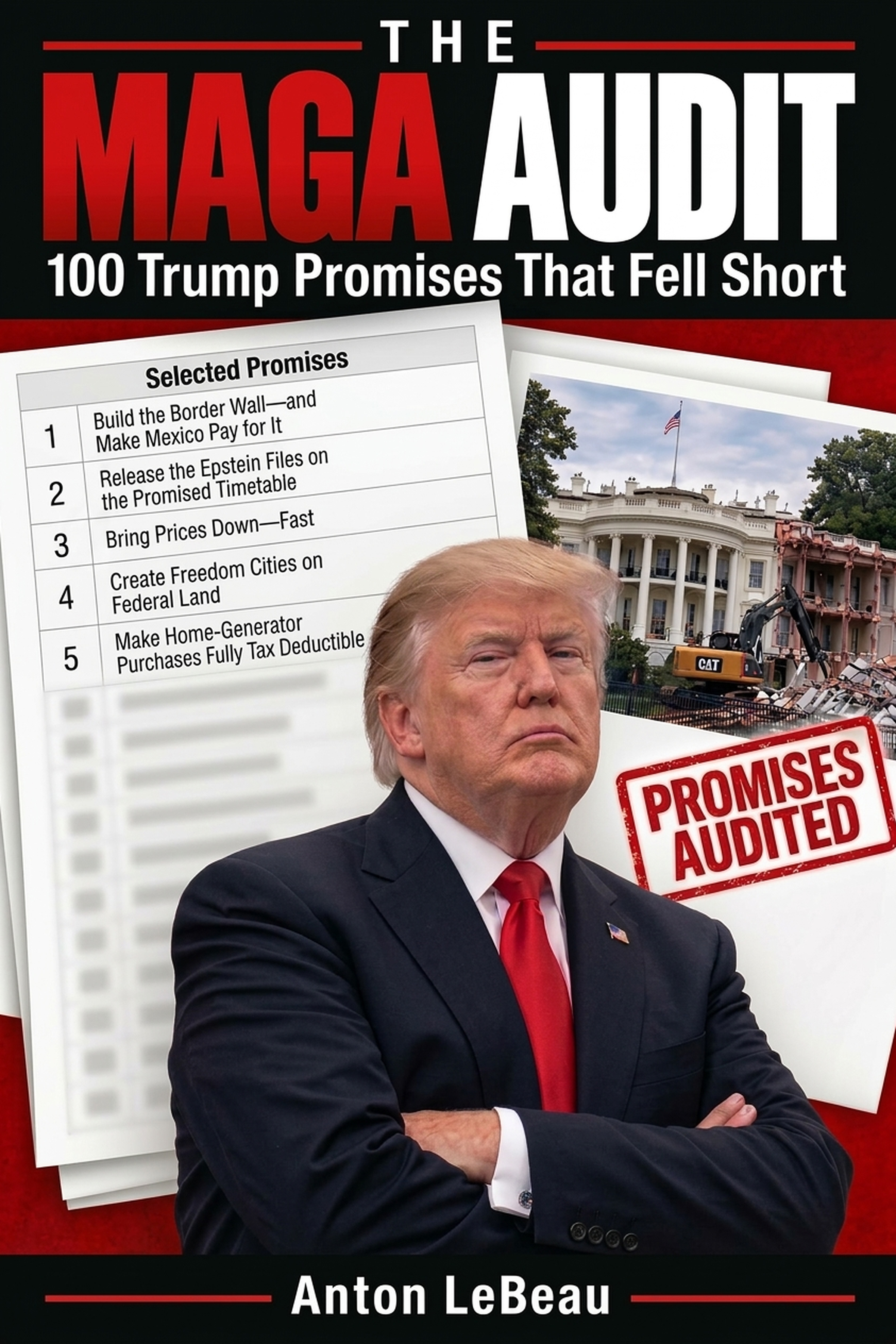
It’s widely accepted that President Trump doesn’t keep his promises. Author Anton LeBeau not only agrees with that statement, he set out to meticulously document the lies, deceptions and half-truths of Trump’s years in office. He just published his first book The MAGA Audit: 100 Trump Promises That Fell Short. The 344-page tome analyzes 100 Trump campaign vows he made in his two terms in the Oval Office. LeBeau measures those promises against what he calls “the documented public record.” It’s an ambitious road map into the policy failures of Trump’s regime.
The self-published book dropped September 10. LeBeau, which is not his real name, lives in a southern red state. According to his bio, he’s an army veteran and defense-industry veteran with two decades of auditing experience. He explains more about the book’s purpose and his own politics in this email interview with TheRighting’s Howard Polskin.
Q: Why did you write “The MAGA Audit”?
The idea came to me in 2025, after the first hundred days of Trump’s second term. The administration was frequently using the phrase “promises made, promises kept,” and it caught my attention because it didn’t feel entirely consistent with what I was seeing.
Rather than argue from a general impression, I wanted to go back to the original promises and compare them with the public record. By a year and a half into the second term, I felt enough time had passed to test that phrase seriously.
Obviously, some presidential promises take years to carry out. Others have specific deadlines, depend on actions promised for the first day or first hundred days, or are continuations of commitments made during Trump’s first campaign. The question was not simply whether everything had been completed. It was whether the administration had delivered what was actually promised, whether meaningful progress had been made, and whether the available evidence justified giving it credit.
That became the basic structure of the book: What exactly was promised? What happened afterward? Where did the result fall short? And what credit was due?
Q. What qualifies you to be the person to write book?
I’m certainly not saying I’m the best or only person who could have written it. But I do think my professional background gave me useful tools for the project.
I’m an Army veteran, a former Department of Defense civilian, and I spent more than twenty years working in auditing, government contracting, and export compliance. I have a bachelor’s degree in accounting and an MBA in international business. Much of my work involved researching complicated issues, examining documentation, and writing reports based on the facts I could support.
That experience matters when you’re attempting something as difficult as examining Trump’s promises fairly, especially when nearly everyone has a strong opinion about him, whether positive or negative.
I don’t think having an auditing background automatically makes anyone objective. What it gives you is a discipline: identify the claim, follow the evidence, document how you reached the conclusion, and acknowledge facts that do not fit your original expectations. That is the approach I tried to follow throughout the book.
Q. Is it safe to assume that you’re a Never Trumper?
I guess it depends on how that label is defined.
I’m old enough to remember Donald Trump before “The Apprentice” made him nationally popular. I remember the New York businessman and socialite, the Howard Stern appearances, the Playboy-era celebrity coverage, and the public image he had before he became a Republican presidential candidate. My opinion of him did not begin when he came down the escalator in 2015.
I was genuinely surprised when he won the Republican nomination in 2016. His background was very different from those of the previous Republican nominees I remembered. George W. Bush and Mitt Romney had been governors, and John McCain had spent decades in Congress. Whatever anyone thinks of their eventual records, they entered presidential politics with government experience and conventional policy platforms. Bush’s 2000 campaign, for example, talked extensively about education, taxes, and Social Security—an issue the country was already worried about then and still has not resolved.
Trump had never held public office. His public identity was built largely around celebrity and the image of business success, even though Trump businesses had made six Chapter 11 bankruptcy filings.
His modern political profile also grew through his promotion of the false claim that President Obama had not been born in the United States. And this was coming from the same person who, following the 1989 Central Park attack, bought full-page newspaper advertisements calling for the return of the death penalty. Five teenagers were subsequently convicted in that case, and their convictions were later vacated after another man confessed and DNA evidence supported his confession.
So I had serious doubts about Trump as a presidential candidate long before I began researching this book. Pretending otherwise would be dishonest.
Whether that makes me a “Never Trumper” depends on what someone means by the label. I certainly didn’t approach this project without an existing opinion of him. But I also didn’t approach it with the intention of withholding credit for things he actually accomplished.
The book includes a “Credit Due” section for precisely that reason. My prior opinion of Trump does not determine whether a particular promise was fulfilled. Each finding still has to stand on the documented record.
Q. Who do you hope reads the “The MAGA Audit”?
I hope it reaches a wide range of potential voters, including people who support Trump, people who oppose him, and people who are simply exhausted by the arguments surrounding him.
The book is not trying to tell readers what they have to think. It presents 100 deliberately selected promises that fell short in full or in part, explains what was originally promised, documents what happened, and lets readers consider the results for themselves. It is not a statistical sample of every promise Trump has ever made or an overall score for his presidency.
I also designed it so that it can be used as a reference book. Someone interested in healthcare, immigration, trade, government spending, or foreign policy can go directly to that section without necessarily reading all 344 pages in order.
I think it can be particularly useful heading into the November elections. Trump himself is not on the ballot, but voters will be choosing among candidates who are closely aligned with the administration, candidates who oppose it, and others trying to establish a more independent position. Knowing what the administration actually delivered can help voters evaluate those choices.
Q. What’s the most egregious example of a failed Trump promise?
There are different ways to answer that, so I would distinguish a particularly clear example from one involving serious human consequences.
The border wall is a clear example because the promise had two distinct parts: build the wall and have Mexico pay for it.
Trump made substantial progress on construction during his first term, and construction resumed during his second. Federal agencies installed about 458 miles of border-barrier panels from 2017 through January 2021. Most of that mileage replaced existing barriers, but many of those replacements were significant upgrades. Calling all of that work merely “repairs” would understate what was accomplished, and the book gives the administration credit for it.
The financing promise is another matter. Mexico did not pay for the wall. American taxpayers did. When a promise contains two major components, you cannot treat progress on one as fulfillment of both.
Gaza raises a different question because the consequences are much more immediate.
In July 2025, Trump acknowledged that people in Gaza were starving and announced that the United States would establish new food-distribution centers. He described centers where people could walk in without fences or boundaries restricting access.
The book follows what happened to that specific commitment. There were humanitarian efforts and later improvements in food access, and those developments deserve acknowledgment. But they were not the same as establishing the open-access food centers Trump had announced.
In a situation involving starvation, timing is part of the result. Announcing a distribution system and actually operating that system are very different things when people urgently need food.
The wall and Gaza illustrate two different reasons for conducting a promise audit. The wall shows why each component of a commitment has to be examined separately and why genuine construction work should receive credit even when the financing promise failed. Gaza shows why the real-world consequences and timing of a promise can matter just as much as the announcement itself.
Buy The MAGA Audit: 100 Trump Promises That Fell Short