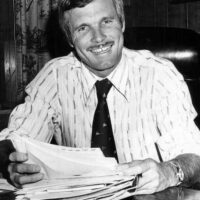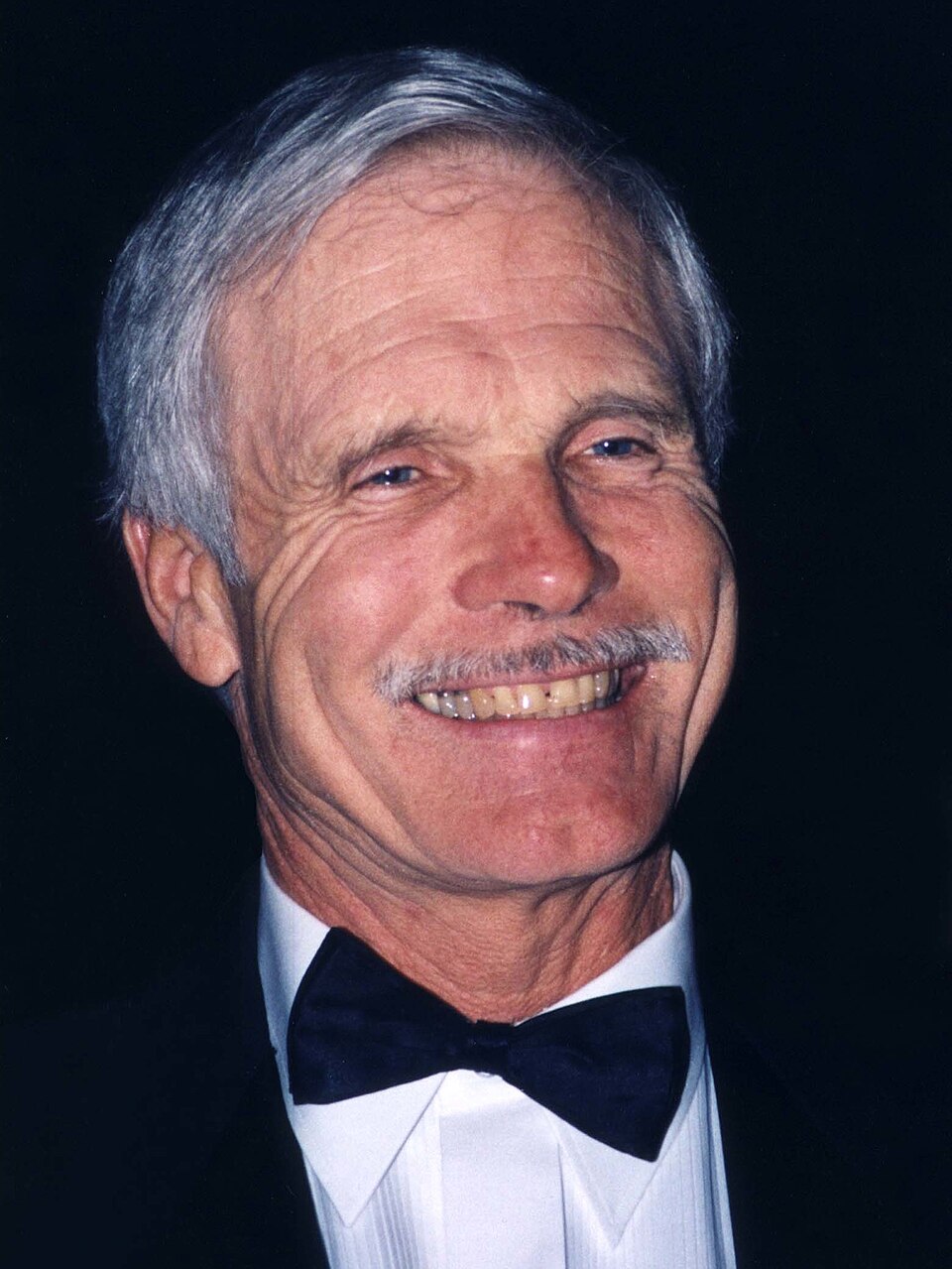
When I read that Ted Turner died on Wednesday, May 6 at age 87, my own memory flood began. It was February 1990, I was a rookie reporter who, after months of trying, had finally scored a sitdown with the CNN founder, the visionary “Mouth of the South,” who kickstarted the 24-hour news cycle that prepped us for the perpetual dopamine brain feed that has virtually everybody pixel-hooked today.
I was working on a cover story about CNN’s upcoming 10th anniversary for Channels, a now-defunct magazine. A couple of weeks before, I’d been notified that “Mr. Turner will give you 15 minutes” if I could make it to CNN headquarters in Atlanta.
Those headquarters were topped by Ted’s eye-popping penthouse. His office was about the size of a regulation basketball court; glass cases throughout were filled with his world-class sailing trophies and other awards. I knew he’d won the 1977 America’s Cup sailing race and that win, along with his public drunkenness in that victory’s wake had helped him earn the nickname “Captain Outrageous.”
Ted greeted me at the door warmly, jacket off, tie askew, in stocking feet. He grabbed my firm hand, put his other arm around me and said: “Max! Why ya only want 15 minutes? What we gonna say in 15 minutes that would mean anything to anybody?” For the next 90 minutes, it was all TCM; meaning Turner’s Classic Monologue: Non-stop selling his non-stop news machine and spot-on potshots at the bloated legacy news competition, all fueled with his trademark savvy Southern salesman charm.
At the time, Ted was shopping for a new CNN president to guide his 24-hour news machine into its second decade. A number of his in-house lieutenants were calling me off the record, lobbying for the job.
Eighteen months earlier, NBC had made the controversial decision to anoint Michael Gartner, a former president of the Des Moines Register and senior USA Today executive as head of its news operation. In the wake of the Gartner appointment, I asked Ted who he was looking at to take CNN into the next decade. “Well, I can tell you this,” he said. “I ain’t going to hire some news executive to do the job.”
Six months later, in a typical bipolar multimillionaire fashion, Ted hired Tom Johnson away from his post as publisher and CEO of The Los Angeles Times to head up the network.
As noted in the ocean of obits, including The New York Times, Ted Turner was a man of seemingly wild-swinging contradictions, simultaneously marketing himself as both a right-friendly GOPer and an anti-nukes, tree-hugging environmentalist.
One day he was making nice with North Carolina segregationist Sen. Jesse Helms; the next, in a typical bait-and-switch, he was fishing with Cuban dictator Fidel Castro.
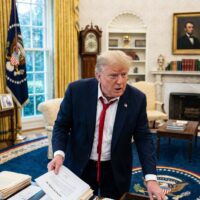
On the one hand, his buccaneer mayhem marketing, womanizing and holy roller declarations of whatever served his interest in the moment makes comparison to Donald Trump—a fellow son of extreme privilege—easy and inevitable. But it’s worth noting that key elements set two of the most consequential figures in modern media history starkly apart.
Sure, both men have had three wives. Trump’s current spouse, the First Lady of the USA, was the star of the $40 million documentary Melania, financed by Amazon. In contrast, Turner’s last marriage was to two-time Academy Award winner, progressive political activist and former fitness guru Jane Fonda. Turner and Fonda, who wed in 1991 and divorced 10 years later, remained, by both of their accounts, close friends who spoke often and, seemingly, more intimately than the nation’s still married First Couple.
Notably, Ted was frank about his opinion of Trump’s leadership. In a candid 2016 interview in the Hollywood Reporter, he called Trump a “demagogue” and warned of a dangerous “populist” uprising happening in the country, drawing a parallel to Adolph Hitler’s rise in Germany in the 1930s.
In complete contrast to The Donald’s reportedly sham charitable contributions and demeaning treatment of cherished institutions, Ted gave much of his wealth away, including $1 billion to the United Nations. He funded numerous non-profits to fight climate change and promote nuclear disarmament. Without hesitation, he’d often say the most important part of his legacy was his environmental activism. (It is worth noting the cruel irony, years after Trump sold off his media interests that CNN’s constant offer of airtime to Trump during his 2016 White House run put the man who wants his name blazened on everything in the Oval Office.) Indeed, that day I interviewed him in Atlanta, I watched Ted blow off a photo shoot for a soon-to-be published book about the news network’s first decade. “I don’t want my picture on the cover of any damn book,” he bellowed as he stormed out.
The 1990s was a legacy-defining period for Ted. In August, when the bombs began pouring down over Baghdad, it was CNN reporters who were on the ground, going 24/7 with coverage and cementing the concept of a dedicated news network as a viable business, no longer worth deriding as the “Chicken Noodle Network.” The following year, Turner was Time magazine’s pick for Person of the Year. Studio acquisitions he made included buying animation giant Hanna Barbera in 1991, and using its library to create the Cartoon Network. Two years later he launched Turner Classic Movies (TCM), drawing on the MGM film library he’d purchased in 1986 in a deal that nearly bankrupted him. Both became money-making machines, as were his other networks TNT and WTBS, the latter powered by broadcasting the Turner-owned Atlanta Braves.
In that 1990 sitdown, I asked Ted about what he liked to read. (Much to the displeasure of his alcoholic, physically abusive father, Turner had been a Classics major at Brown University.) “I don’t read newspapers or books anymore, I don’t think anybody does much,” Ted said. “It’s like that song on MTV.” Then, with karaoke swagger, Ted sang the chorus to the first music video played on MTV in 1981. “Video killed the radio star/in my mind and in my car/we can’t rewind we’ve gone too far.”
Captain Outrageous? Yes. Captain Contagious? Definitely. R.I.P. Captain Ted.
J. Max Robins is the executive director of the Center for Communication. Formerly the editor-in-chief of Broadcasting & Cable magazine and the TV editor and columnist at Variety; he has contributed reporting and commentary for the Wall Street Journal, The New York Times. New York magazine, The Los Angeles Times, Columbia Journalism Review and The Hollywood Reporter.